
End of Tenancy in the UAE: What You Owe on Exit — and What the Law Does Not Let Them Take From Your Deposit
End of Tenancy in the UAE: What You Owe on Exit — and What the Law Does Not Let Them Take From Your Deposit
Three PDFs a week before the van are not the law. They are a net
A studio in Dubai or a villa in Abu Dhabi. Ejari or Tawtheeq. Furnished or not. A few weeks before the keys, the chat fills with paper: a move-in clean, a full repaint, a “maintenance” quote with air-conditioning, pumps, a control panel, new light fittings. The total looks a lot like the deposit. The message is the same: sign, pay, or we keep the money.
That is how ordinary people are squeezed on the way out — not in a courtroom, but with letterheads. We are a contracting company, not a law firm. We read these bills line by line: is this work for the person leaving, or for the next listing? If that reading matches the statute, people need to see it before the deposit becomes someone else’s renovation.
What follows is a rule that works for any handover in the UAE. The live example later is one real stack of quotes, not a market tariff. This is general information, not legal advice. The signed contract and the law of the emirate decide the case. The Arabic text of the law prevails over any translation.
One rule in plain language
The tenant returns the home as it was received, minus ordinary wear and anything that happened without their fault. The owner keeps the property fit for use: structure, air-conditioning, water, electrics, pumps, the pool if there is one. The tenant looks after someone else’s thing as if it were their own, and pays for what they broke.
While you live there, you change a dead bulb. That is household custom. On exit, “supply and installation” of a bundle of new fittings, a pump rewind and a gas charge are not household custom. They are the asset being maintained. The deposit is security. It is not a renovation budget for the next occupant.
A contract can move some day-to-day duties onto you: cleaning, a minor-repair threshold, sometimes a repaint. It does not turn a pool panel and a pump set into “tenant smalls” just because they landed in the same PDF.
What the law says — the articles, not a paraphrase
The backbone is federal: the Civil Code. On top of it sits the law of the emirate. In Dubai that is Law No. 26 of 2007 (as amended by Law No. 33 of 2008). In Abu Dhabi it is Law No. 20 of 2006. Other emirates have local rules; the federal articles still apply.
The owner keeps the property fit for use
Unless otherwise agreed by the parties, the Landlord will, during the term of the Lease Contract, be responsible for the Real Property’ maintenance works and for repairing any defect or damage that may affect the Tenant’s intended use of the Real Property.
Dubai Law No. 26 of 2007, Article 16. Official text: dlp.dubai.gov.ae
Unless the parties agreed otherwise, maintenance and the repair of any defect that stops the tenant using the home sit with the landlord — not with the person who is leaving.
Further, the Landlord will be responsible for any defect, damage, deficiency, and wear and tear occurring to the Real Property for reasons not attributable to the fault of the Tenant.
Dubai Law No. 26 of 2007, Article 17
Wear, shortage and damage that are not the tenant’s fault are the owner’s. Faded paint, a compressor that reached the end of its life, a pump that used up its hours — that is this article, not your deposit.
The Lessor shall maintain the leasehold to keep it fit for utility and carry out all necessary repairs excluding rental repairs during the rental period unless otherwise agreed.
Abu Dhabi Law No. 20 of 2006, Article 7. Official text: services.dari.ae
Abu Dhabi draws the line in the statute itself. Article 1: necessary repairs are urgent works and anything needed for the tenant to use the home — the lessor’s. Rental repairs are the minor works a tenant customarily does. Article 14 repeats: the tenant does only custom-required or agreed rental repairs. Rewinding a booster pump is not a rental repair. Replacing a smashed shade is.
The lessor shall be obliged to repair any defect in the thing hired which has an effect on the deriving of the intended benefit.
UAE Civil Code, Federal Law No. 5 of 1985, Article 767(1)
The federal backstop in every emirate: a defect that stops the intended benefit of the lease is the lessor’s to repair.
What sits with the tenant
The Tenant must pay the Rent on due dates and maintain the Real Property in such a manner as an ordinary person would maintain his own property.
Dubai Law No. 26 of 2007, Article 19
The lessee must take such care of the thing hired as a reasonable man would take of his own property.
UAE Civil Code, Article 776
The lessee must, during the continuance of the lease, carry out such repairs as have been agreed or are customary for him to carry out, and he must clean the thing hired and remove from it any dirt or waste in accordance with custom.
UAE Civil Code, Article 779
Care for it as your own. Do what is customary or written. Keep it clean. No more. Abu Dhabi Article 15 adds: water, power and telephone are your bills; “any damages he may cause” means damage you caused — not the house wearing out.
The deposit and the day of the keys
When entering into a Lease Contract, the Landlord may obtain from the Tenant a security deposit to ensure maintenance of the Real Property upon the expiry of the Lease Contract, provided that the Landlord undertakes to refund such deposit or remainder thereof to the Tenant upon the expiry of the Lease Contract.
Dubai Law No. 26 of 2007, Article 20
The deposit is taken to secure maintenance at the end. The remainder must come back. It is not a second month of rent and not a paint invoice for the next listing.
Upon the expiry of the term of the Lease Contract, the Tenant will must surrender possession of the Real Property to the Landlord in the same condition in which the Tenant received it at the time of entering into the Lease Contract except for ordinary wear and tear or for damage due to reasons beyond the Tenant’s control.
Dubai Law No. 26 of 2007, Article 21
Hand it back as received, except for ordinary wear and tear and damage beyond your control. If you disagree, the tribunal decides — not a signature “so we can close today.” In Abu Dhabi, Article 22 requires handover at expiry; what must be repaired is still Articles 7 and 14 plus the Civil Code.
Two numbers you will see online are not in the statute. A Dubai deposit of “5% unfurnished / 10% furnished” is market custom; Article 20 names no percentage. A “refund in 30 days” rule is not in Law 26/2007 either. In practice the money moves after keys, inspection and the final utility closure. If it is held without documents, use the forum of the emirate: the Rental Disputes Center in Dubai, the Lease Disputes Resolution Committee in Abu Dhabi.
How to read any exit quote
A contractor paper is not a court order. It is an offer to whoever commissioned it. The same method works for a studio, a 1BR and a villa.
- Whose name is on it? Owner, agent, or you. A quote written for the next listing is not automatically your bill.
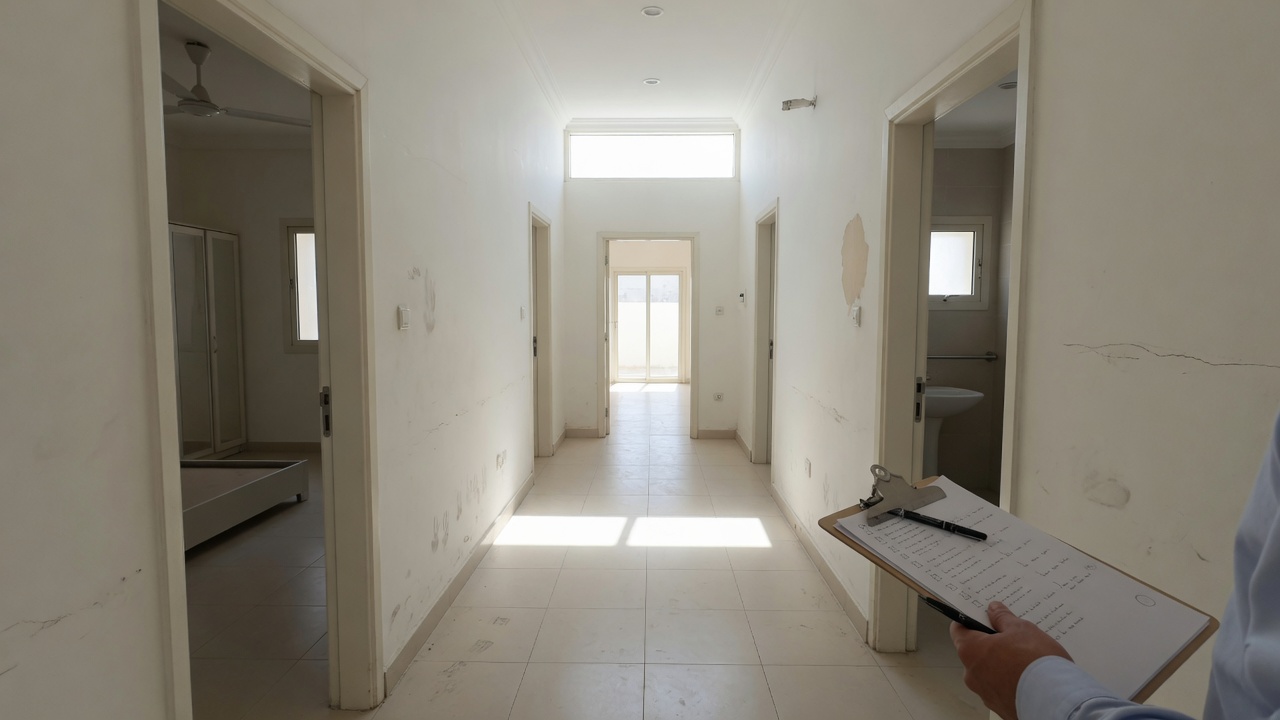
- Your mark — or a refresh for the market? Faded paint and light scuffs are wear, Articles 17 and 21. A new frame, a full skim and an “original” repaint of everything are an asset job.
- Would this exist if nobody had lived here? A compressor, gas, a pump, a panel, an outdoor light in the sun — service life of equipment. Not “you lived badly.”
- A household bulb, or supply of fittings? It died while you lived there — you change it. On exit, supply and installation of a bundle of new lights is replacement of the owner’s hardware, unless a shade is smashed.
- Is there already an AMC? If the systems are on a maintenance contract, an exit invoice for the same AC and pumps is a second charge for the same work.
- Is the small print even aimed at you? “50% to reserve”, “100% advance”, “special discount applied” with no figure — contractor terms, not a tenant tariff.
- Only then open the contract. Look for painting, cleaning, a minor-repair threshold (often AED 500 or 1,000 per incident). A clause can move household items. It does not turn a pump into a light bulb.
The same nets, in any floor plan
A move-in clean. The law asks for cleanliness according to custom (Civil Code 779), not a commercial package with a deposit to reserve the date. Empty, swept, no food, no wet bins — yours. The agent’s most expensive PDF — not yours. If you left it dirty, a deduction against an invoice is fair. If you cleaned it, photograph the empty rooms on the morning of handover.
A full repaint. Many leases do say “tenant shall repaint.” Read the words. Where the contract is silent, fade and light marks are ordinary wear and tear, Article 21. Even where a clause exists, it does not require you to build a partition, skim from scratch and paint every wall, including staff areas you never damaged. Ask for a marked scope: your damage in one column, old walls in the other.
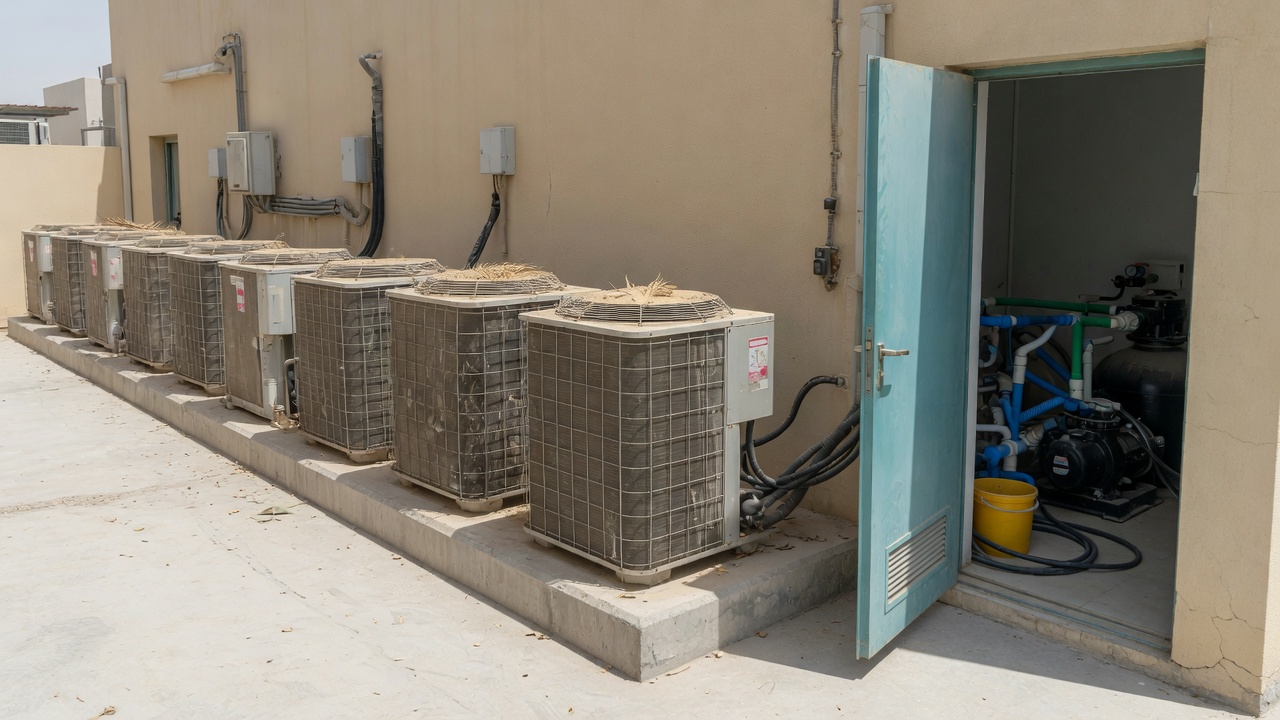
Air-conditioning, water, electrics, the pool. Necessary repairs and intended use. A summer without cold air, a house without water, a dead pool panel — not housework. Motors, leaks, gas, rewinds, bearings, contactors sit with the owner until they prove you killed the unit.
Lights. A bulb in daily life is yours. A bundle of new fittings on exit is not. Sun and irrigation kill outdoor lights; LEDs reach the end of their life. You pay for a smashed shade, not for a list of everything that is dark.
Furniture, if the home is furnished. The same line. A sofa worn after two years is not yours. A torn cover or a smashed fridge shelf is. You need the move-in inventory. Without it the dispute is one story against another.
A live example: how the net looks on paper
Not a tariff. One real exit, figures rounded, names and the address removed. A multi-bedroom villa, Abu Dhabi, 2026. The outgoing tenant was sent three contractor quotes as one pack.
| What arrived | Order of the sum | How to read it |
|---|---|---|
| Internal deep clean, materials included, money up front to reserve | a few thousand | A package for the next occupant. The law asks for cleanliness, not this letterhead |
| Original paint on every wall, plus a new frame and skim in a staff bathroom | around ten thousand | The rate may be market. The payer is not the tenant: this is an asset refresh and construction, not making-good |
| AC with gas, booster pumps sent for rewind, pool pumps and panel, supply and installation of light fittings | a few thousand | The house’s plant and hardware. Not the outgoing tenant’s debt |
Together, more than twenty thousand — about a typical deposit. If the home was left reasonably clean and nothing was broken, the honest debt on a pack like this is close to zero. “Small electricals” sometimes carved out for politeness are not a norm and not a fair tenant share. They are a dispute ceiling, and only with proof you broke the fitting.
The same template works on a 1BR: instead of a pool pump you get the building’s riser and the chiller; instead of a staff-bathroom frame you get “we always repaint every wall.” Read the lines, not the total.
Ready-to-Use Response Template for Your Landlord or Agent
If you receive an inflated exit estimate, do not get drawn into an emotional dispute and do not accept the total sum. Send a polite, legally anchored written response (via email or formal messaging):
Dear [Landlord/Agent],
Thank you for sharing the handover estimates. Having reviewed the line items, we note that several charges (including major HVAC maintenance, pump overhauls, and general wall repainting) fall under necessary repairs and ordinary wear and tear, which are the Landlord’s statutory obligations pursuant to Articles 16, 17, and 21 of Dubai Law No. 26 of 2007 (and/or relevant provisions of UAE Civil Code).
Please provide an itemized breakdown distinguishing tenant-caused damage from customary asset upkeep, supported by actual paid invoices and the move-in condition report. We remain ready to settle any verified damages beyond fair wear and tear and expect the refund of the remaining security deposit as required by Article 20.
Response template for an inflated handover estimate (ready to copy)
What to do on any handover
Sixty days out. Retrieve the two cornerstones of your legal protection: your registered Ejari (Tawtheeq) contract and the original Condition Report (the move-in handover report with comprehensive photos). The tenant’s strong standing rests entirely on this pairing: without an intake report, it is far easier for a landlord to claim that preexisting chips, scuffs, and aging appeared during your tenancy. Read the contract: painting, cleaning, minor-repair threshold, who pays for AC servicing, whether there is an AMC. Photograph every room in daylight — walls, ceilings, appliances, bathrooms, outdoor plant if you can reach it. Write to the agent: a written snag list before contractor quotes. A list of defects and a renovation budget are different papers.
Thirty days out. If quotes arrive, do not argue the total. Argue the lines: owner / tenant / depends, citing the relevant statutory articles (use the ready template above). Commission an independent quote only for what is genuinely yours. Close DEWA, ADDC or the utility of that emirate so the final bill cannot be used to sit on the whole deposit.
Fourteen days and handover day. Do only your work. Do not pay 100% in advance to the agent’s contractor for someone else’s refresh. Joint inspection in daylight, same route as move-in. Faded paint: “wear — disputed.” Keys only against a dated receipt. Do not sign “I agree to all deductions.”
After the keys. Send the utility final bill (DEWA, ADDC) in the same week. Any deduction requires an itemised list and paid invoices, not a screenshot of someone else’s quote. If the deposit is not returned — a concise written demand citing the law, followed by the relevant tribunal (RDC in Dubai / LDRC in Abu Dhabi). In a dispute, documentation decides everything: an active or closed Ejari (Tawtheeq) contract, deposit payment receipt, and a direct line-by-line comparison between your intake Condition Report and the exit inspection with both photo sets. When you hold an intake report, the burden of proving fault for every defect shifts squarely to the landlord.
What not to do, even under pressure
- Do not treat three PDFs as a verdict.
- Do not fund the next tenant’s renovation so that “the file can close today.”
- Do not confuse a market rate with the right payer. The paint figure can be fair — and still not yours.
- Do not confuse a household bulb with an exit invoice to supply new fittings.
- Do not stop the rent as a protest. In Dubai, unpaid rent thirty days after notice is a ground for eviction (Article 25). Dispute separately. Pay the rent.
- Do not skip the contract. Read the cleaning and painting clauses. A line that says “tenant does all maintenance” does not cancel intended use or necessary repairs.
A note from us
Friends bring the same papers and ask what is actually theirs. We wrote down the answer so it does not live only in a chat. If it is useful — keep it, pass it on.
Our work is renovation and fit-out: longer projects, a clear scope, a finished home. This page is not an offer to handle a handover package. If you are planning that kind of project, we are here. If you only needed to read the quotes — you already have what you came for.
Masterwork Space — Fanil and Marsel Shadmanov. Fit-out and renovation in Dubai since 2024; the house has worked since 2008. DET trade license 1374445. office@masterworkspace.ae · +971 58 179 1439.
A contractor’s reading of common practice and the published wording of the law. Not a legal opinion, and not a promise of how any committee will rule. Statutes and contract forms change. Check the current Arabic text and your own lease. If the deposit is large enough to fight over, take licensed advice.
Frequently Asked Questions
Who does the law say must fix air-conditioning and pumps on exit?
The owner. Dubai Law 26/2007, Articles 16 and 17: maintenance, and wear that is not the tenant’s fault. Abu Dhabi Law 20/2006, Articles 1 and 7: necessary repairs sit with the lessor. The tenant pays only if they broke the unit and that can be shown.
Must I replace bulbs and light fittings at handover?
While you live there — yes, that is custom (Civil Code 779). On exit, “supply and installation” of new fittings is replacement of the owner’s hardware. You pay for a smashed shade, not for a bundle of lights that simply reached the end of their life.
Is a full repaint or a professional deep clean mandatory?
Only if your contract says so, or there is damage beyond wear. Dubai Article 21 expressly carves out ordinary wear and tear. Cleanliness according to custom — yes. The agent’s most expensive package with money up front — no.
What if the contract says the tenant does all maintenance?
“Unless otherwise agreed” in Article 16 is a real phrase. It can move household items and a small threshold. It does not usually cancel the duty to keep the home fit for use (Dubai Article 15, Abu Dhabi Article 7, Civil Code 767). Structure, a major AC failure, a pump set and a pool panel still need a basis — and your fault.
Can they keep the deposit on the strength of someone else’s quote?
Dubai Article 20: refund the deposit or the remainder. A quotation is not a cost incurred. Ask for an itemised list and paid invoices. Three unaccepted offers are a dispute, not a closed file.
Where do I go if the deposit is not returned?
In Dubai — the Rental Disputes Center (RDC, rdc.gov.ae); in Abu Dhabi — the Lease Disputes Resolution Committee (LDRC) under the judicial department. Applications are submitted online. Remember: the bedrock of a tenant’s position before the RDC / LDRC is not emotion, but the pairing of a registered Ejari (Tawtheeq) contract and the original Condition Report (move-in handover report with photos). Without an intake report, it is far easier for a landlord to claim that preexisting damage occurred during your stay. Also submit: your deposit payment receipt, final DEWA/ADDC clearance certificates, written correspondence, and copies of the contractor quotes received.
Can you handle the handover works from this quote?
This page is a guide. Our day-to-day work is renovation and fit-out, not move-out packages. If you are planning a full project, write to us. If you only needed to understand the papers, you already have the answer here.